
Lawrence Park Real Estate: Toronto’s Garden Suburb
Tudor Revival architecture, curving tree-lined streets, and some of the best schools in Toronto. Lawrence Park is one of the city’s most established and prestigious residential addresses, and one of the most common starting points for families thinking about what comes next.
Talk to Us About Lawrence Park
Buying, selling, or thinking about your next move. Let’s have an honest conversation.
Or call 416-486-8282
What is Lawrence Park, Toronto, known for?
Lawrence Park is known as one of Toronto’s earliest and most prestigious garden suburbs, developed from 1908 by the Dovercourt Land Company under Wilfrid S. Dinnick. The neighbourhood is defined by Tudor Revival, Georgian, and English Cottage architecture from the 1910s to 1940s, curving tree-lined streets, generous lots, mature tree canopy, and proximity to Blythwood Ravine, Chatsworth Ravine, and Alexander Muir Memorial Gardens. It consistently ranks among the most desirable and expensive residential addresses in the city, with average detached home prices of $3,471,000 as of Q3 2025 (TRREB).
For families who have lived here for 20 or 30 years, it’s also one of the most common starting points for downsizing conversations. The home that was perfect when the kids were young is now a lot to maintain. The equity is significant. What comes next is the question. The answer usually starts with an honest assessment of the property's value and the right next move.
Thinking about selling your Lawrence Park home? Othen Group’s Complete Toronto Downsizing Guide walks through timelines, market value, neighbourhood options, and the questions families most often wish they’d asked earlier. Read it before booking a conversation with Jacquie Othen.
What is the difference between Lawrence Park and Lawrence Park South?
This is one of the more confusing distinctions in Toronto real estate. Here’s the honest answer.
Lawrence Park (the historical garden suburb, Avenue Road to Yonge, Lawrence to Blythwood Ravine) is distinct from the City of Toronto’s “Lawrence Park South” designation, which extends further west toward Bathurst and south toward Eglinton. As of March 2026, the historical core between Avenue Road and Yonge (the Tudor Revival crescents most buyers are looking for) carries average detached prices of $3,471,000 (TRREB Q3 2025). Properties in the broader Lawrence Park South designation can be $500,000–$1M less, depending on location.
When most buyers say “Lawrence Park,” they mean the historical garden suburb developed from 1908 by the Dovercourt Land Company. That area runs from Avenue Road east to Yonge Street, from Lawrence Avenue south to Blythwood Ravine and Alexander Muir Memorial Gardens. Yonge Street is the eastern boundary. This is the area with the curving crescents, the Tudor Revival architecture, and the ravine-adjacent properties that define Lawrence Park’s reputation.
The City of Toronto’s official neighbourhood designation, “Lawrence Park South,” is a broader area that extends westward toward Bathurst and southward toward Eglinton, encompassing more of the Allenby and Forest Hill edges. This is what Statistics Canada and the City use for data purposes. The core character most buyers are looking for sits in the tighter area between Avenue Road and Yonge.
For practical real estate purposes:
- The historical garden suburb (Avenue Road to Yonge, Lawrence to Blythwood): predominantly detached heritage homes, low turnover, $3M+ pricing
- The broader Lawrence Park South area (extending west toward Bathurst and south toward Eglinton): more diverse property types, some condos, connects to the Yonge and Eglinton market
- Lawrence Park North: the City designation for the area north of Lawrence Avenue extending toward Sheppard, between Yonge and Bayview
When Othen Group describes Lawrence Park to buyers, the distinction between the historical garden suburb and the broader Lawrence Park South designation is always made clear. Knowing which side of these boundaries a property is on affects pricing, school catchments, and transit access.
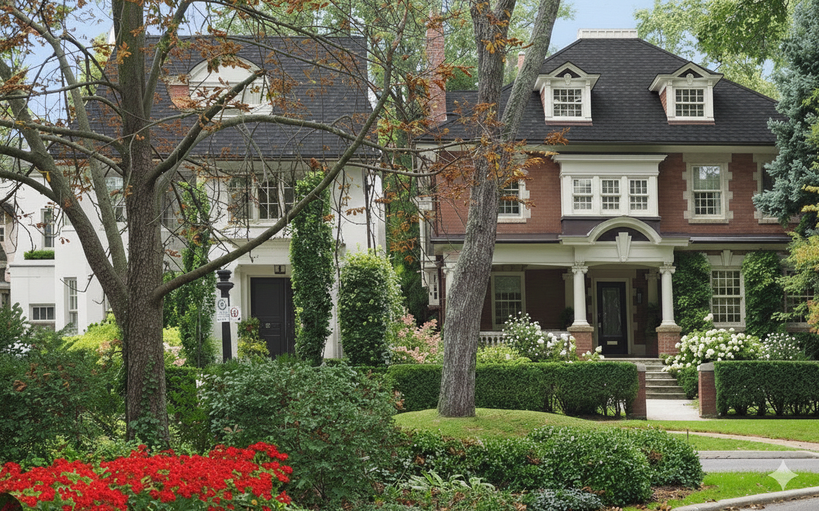
The curving, tree-lined streets of the historical Lawrence Park garden suburb, west of Yonge Street between Avenue Road and Yonge.
How walkable and transit-accessible is Lawrence Park?
Primarily car-dependent due to its residential character, but considerably more accessible than comparable suburban areas thanks to Line 1 access at Lawrence Station and Yonge Street bus service.
As of March 2026, Lawrence Park scores 50–72 Walk Score (depending on street) and 77 Transit Score (Excellent Transit). Lawrence Station on TTC Line 1 Yonge-University is approximately 22 minutes from Union Station. Interior residential streets are car-dependent, with most households owning at least one vehicle. Yonge Street bus routes, including 24-hour service, provide transit access for residents without a car.
Transit Access
- Lawrence Station (Line 1 Yonge-University): rapid access to downtown and North York Centre
- Eglinton Station is also accessible to residents in the southern part of Lawrence Park South
- Frequent bus routes on Yonge, Lawrence, Avenue Road, and Mount Pleasant Road (approximately 8 routes serve the area)
- Multiple 24-hour routes on Yonge Street for late-night access
Driving & Car Access
- Highway 401 on-ramp is approximately 10 minutes by car via Yonge Street
- Don Valley Parkway is accessible via the 401 interchange, though most residents commute primarily via Yonge Street and the subway
- Lawrence Park is primarily car-oriented; most households have at least one vehicle
- Parking on residential streets is generally available, though school-adjacent streets are congested at drop-off and pick-up times
What is the average house price in Lawrence Park, Toronto?
As of Q3 2025, the average sold price for detached homes in Lawrence Park South was $3,471,000, with properties selling at 96% of the asking price and averaging 37 days on market. Condo sales averaged $1,158,000. All property types combined averaged $2,987,930, with 43 properties sold from 94 new listings during the quarter. Source: TRREB Statistics, Q3 2025.

We walk you through current market conditions before you make any decisions, buying or selling.
The price range in Lawrence Park is significant. Lot size, ravine adjacency, condition, and whether the home is an original heritage property, a renovation, or a custom rebuild all significantly affect the number. Properties on prestige crescents or with ravine views command meaningful premiums over comparable street-facing homes.
What the market numbers actually mean:
- 96% of asking price: This is a balanced market with limited room for lowball offers on well-priced properties
- 37 days on market for detached: longer than core Toronto, reflecting a buyer pool that is smaller but highly qualified
- Custom rebuilds: $450–$650+ per sq ft for construction only, plus design, permits, HST, and 10–15% contingency. Total costs run well above the construction line item
- Ravine properties require Conservation Toronto approval. Get a survey before making an offer on any lot touching the ravine system
- Limited condo and semi-detached inventory within the historical garden suburb; condo supply concentrates toward Yonge and Eglinton
What are the rental prices in Lawrence Park, Toronto?
Lawrence Park South rental prices sit well above the Toronto average, reflecting the neighbourhood’s premium character, school catchment access, and proximity to Line 1.
As of early 2026, average rents in Lawrence Park South are approximately $2,433/month for a one-bedroom apartment and $3,267/month for a two-bedroom (Apartments.com active listings data, 2026). These figures are meaningfully above the Toronto-wide average of approximately $2,035/month, reflecting the neighbourhood’s premium address, school catchment, and proximity to Line 1 subway. Ontario’s 2026 rent increase guideline is 2.5% for rent-controlled units.
What renters pay a premium for
- LPCI and Blythwood Junior PS catchment access: Lawrence Park South commands a measurable rent premium over comparable East York units due to school access
- Lawrence Station (Line 1 Yonge-University): direct rapid transit to downtown Toronto reduces the need for a second car
- Neighbourhood character: tree-lined streets, ravine trails, and low-density residential settings are significant lifestyle factors for renters
- Proximity to the Yonge Street corridor: grocery, pharmacy, and everyday retail accessible without a car for residents near Yonge
Rental supply in Lawrence Park
The historical garden suburb is almost entirely owner-occupied detached homes. Rental supply is concentrated in apartment buildings along or near Yonge Street and Lawrence Avenue East, as well as in the broader Lawrence Park South designation. Vacancy rates in the area are extremely low — typically below 1.5% for purpose-built units.
Lawrence Park rental properties are frequently managed by individual owners rather than professional management companies. Renters looking for a long-term lease in the area typically work with a buyer’s agent or a dedicated rental specialist who is familiar with the local stock.
How do you sell a Lawrence Park home quickly and for the right price?
Lawrence Park is a specialist market. Heritage valuations, ravine setbacks, school catchments, and a qualified buyer pool that expects an impeccably presented home — this is not a DIY sale.
Selling a home in Lawrence Park involves five key steps: pricing accurately from day one, preparing the property with professional staging, launching with full MLS and digital marketing, managing qualified buyer enquiries, and negotiating to close above asking. As of March 2026, Lawrence Park detached homes average 37 days on market — longer than in core Toronto — suggesting overpriced homes sit on the market longer. Jacquie Othen, SRES, has facilitated family home transitions in Lawrence Park and the midtown and east Toronto for 15+ years. Othen Group includes free professional staging through Kelly Allan Design for every Lawrence Park listing, at no deduction from proceeds.
Step 1: Price it right from day one
Lawrence Park buyers are sophisticated and well-informed. They review comparable sales before viewing. A $3.5M+ home priced $200K above comparable solds doesn’t generate offers — it generates doubt. Jacquie Othen’s pricing approach begins with a detailed comparable market analysis (CMA) of recent Lawrence Park sales, accounting for lot size, ravine adjacency, condition, and whether the home is heritage or a custom rebuild.
Step 2: Stage professionally — at no cost
Every Othen Group Lawrence Park listing is staged by Kelly Allan Design at no cost to the seller. Staging is not optional at this price point — the buyer paying $3.5M expects to walk into a home that feels exceptional. Othen Group’s free professional staging offer saves sellers $3,000–$10,000+ compared to hiring a stager independently.
Step 3: Full MLS + targeted marketing launch
Every Lawrence Park listing goes live on MLS with professional photography, a virtual tour, and targeted digital marketing to buyers actively searching above $3M. Jacquie Othen’s agent network in midtown and east Toronto means qualified buyers hear about Lawrence Park listings before they hit the public market. This is how homes move in under 30 days in a market that averages 37.
Step 4: Manage the buyer pool
Lawrence Park buyer enquiries come from three distinct pools: families targeting LPCI, executives seeking a prestigious address, and international buyers seeking long-term Toronto real estate. Jacquie Othen pre-qualifies serious buyers, identifies risks associated with conditional offers, and manages the offer process to protect your interests throughout. Lawrence Park buyers often compete — and knowing how to structure a process that generates competition is a skill, not an accident.
Step 5: Negotiate and close above asking
Lawrence Park’s 96% sale-to-list ratio is an average, not a ceiling. Well-priced, well-staged Lawrence Park homes close above asking when the process is managed correctly from day one. Jacquie Othen is transparent on what “above asking” actually looks like in this market — and honest when conditions don’t support it. The goal is maximum net proceeds, not a number that sounds good before negotiations begin.
What is daily life like in Lawrence Park, Toronto?
Lawrence Park is primarily residential. The neighbourhood is quiet and established, and most daily errands require either a short drive or a subway trip. Here’s what that looks like in practice.
Lawrence Park's daily life centres on Yonge and Lawrence Village for everyday needs — groceries, coffee, pharmacy, and casual dining are concentrated at this intersection. As of March 2026, the neighbourhood itself has limited walkable commercial amenities beyond the Yonge Street strip. Most residents own a car or rely on Line 1 Yonge-University at Lawrence Station for commuting and errands. The neighbourhood’s core appeal is its residential character: quiet streets, ravine access, mature canopy, and a strong sense of established community.
Groceries & Everyday Retail
- Metro and Loblaws are accessible along Yonge Street and at nearby Lawrence Square
- Pusateri’s Fine Foods (Avenue Road): premium grocery option for the Lawrence Park corridor
- Whole Foods Market (Avenue Road at Eglinton): accessible by car or Line 1 for organic and specialty grocery
- Shoppers Drug Mart: multiple locations along Yonge Street and Lawrence Avenue
- LCBO and Beer Store are accessible in nearby commercial areas
Restaurants & Coffee
- Lawrence Village dining strip (Yonge and Lawrence): a mix of casual and upscale dining serving the immediate neighbourhood
- Harbour Sixty and Buca are accessible downtown via Line 1 for celebratory dining
- Longo’s Lawrence Avenue location: popular for the prepared food section and specialty items
- Starbucks, Timothy’s, and independent cafes along Yonge Street north of Eglinton
- Grill on the Danforth and comparable midtown dining options within a short subway ride
Fitness & Recreation
- GoodLife Fitness: locations on Yonge Street accessible from Lawrence Station
- North Toronto Memorial Community Centre (Davisville Village): pools, gyms, ice, and fitness programming
- Sherwood Park: outdoor tennis courts and trail running along the ravine system
- Multiple yoga studios and pilates studios along Yonge between Eglinton and Lawrence
- The Cricket Club (St. Clair Ave W): private club popular with Lawrence Park residents
What parks and green spaces does Lawrence Park have?
The garden suburb character of Lawrence Park is not just marketing language. The ravine access, mature canopy, and park density are genuine and measurable. It is one of the best-parked neighbourhoods in midtown Toronto.
Lawrence Park is bounded by two ravine systems (Blythwood Ravine to the south and Chatsworth Ravine within the neighbourhood) and Alexander Muir Memorial Gardens on its southern edge. Sherwood Park (off Sherwood Avenue) provides wading pools, walking trails, an off-leash dog area, and a large playground. The Kay Gardner Beltline Trail, accessible from the neighbourhood, connects to the broader Toronto trail network. As of March 2026, this ravine and park density is one of the defining features that distinguishes Lawrence Park from other midtown Toronto neighbourhoods at comparable price points.
Ravines & Gardens
- Alexander Muir Memorial Gardens: formal gardens and ravine trails on the southern boundary, the defining green space of Lawrence Park proper
- Blythwood Ravine: natural ravine forming the southern edge of the historical garden suburb
- Chatsworth Ravine: additional ravine system within the broader Lawrence Park area
Parks & Trails
- Sherwood Park: wading pools, walking and running trails, off-leash dog area, large playground, picnic facilities, and public washrooms
- Lytton Park: in the adjacent Lytton Park neighbourhood to the west, accessible to Lawrence Park residents
- Lawrence Park itself: a community park within the neighbourhood
- Kay Gardner Beltline Trail: a multi-use walking and cycling trail connecting to the broader city trail network
Recreation & Facilities
- Sherwood Park community facilities: sports fields and tennis courts adjacent to the ravine system
- North Toronto Memorial Community Centre: pools, gyms, and programming in nearby Davisville Village
- Multiple TTC-accessible community centres for broader programming needs
- Two public library branches within the neighbourhood
What are the best schools in Lawrence Park, Toronto?
Lawrence Park has some of the most sought-after school catchments in Toronto. But the boundaries are specific, and where you are within the broader area determines which school your child attends. Always confirm the catchment with the TDSB School Finder before purchasing.
Lawrence Park Collegiate Institute (LPCI) is the public secondary school most buyers specifically target, but its catchment does not cover every property marketed as “Lawrence Park.” At the elementary level, Blythwood Junior Public School (JK–6) is the primary feeder for the historical core between Avenue Road and Yonge. As of March 2026, independent school options within or immediately adjacent to Lawrence Park include Havergal College, St. Clement’s School, and Toronto French School (TFS). Jacquie Othen flags school catchment boundaries in every buyer conversation in this area. Confirm the specific address with the TDSB School Finder before making an offer.
Public schools (TDSB): Lawrence Park core (Avenue Road to Yonge):
- Blythwood Junior Public School (JK–6): primary feeder for the core Lawrence Park area
- Lawrence Park Collegiate Institute (Grades 9–12): one of Toronto’s top-rated public secondary schools
- Northern Secondary School: an alternative secondary option nearby
- North Toronto Collegiate Institute: secondary option for parts of Lawrence Park South
Public schools (TDSB): broader Lawrence Park South area:
- John Ross Robertson Junior Public School
- Allenby Junior Public School
- Glenview Senior Public School
- Forest Hill Junior and Senior Public School
Catholic schools (TCDSB):
- Blessed Sacrament Catholic School (JK–8)
- Marshall McLuhan Catholic Secondary School (nearby)
- Loretto Abbey CSS (nearby)
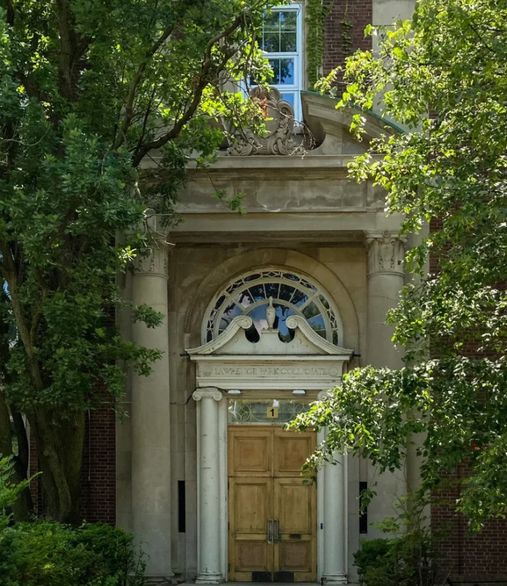
School catchment areas are among the primary drivers of demand in Lawrence Park. Know the boundaries before you make an offer.
Independent Schools
- Havergal College: girls’ school, directly in the area
- St. Clement’s School: girls’ school, Lawrence Park South
- Toronto French School (TFS): co-ed, close proximity
- Crescent School: boys’ school, nearby
- Blyth Academy: alternative secondary, Lawrence Park location
- Bishop Strachan School, Upper Canada College: nearby options
A Note on School Boundaries
Lawrence Park Collegiate Institute is the public secondary school most buyers are specifically targeting. The catchment area is specific: not every property in “Lawrence Park” falls within it. If LPCI is a deciding factor in your purchase, confirm the exact address with the TDSB School Finder tool before you make an offer. We flag this in every buyer conversation we have in this area.
What is being built in and around Lawrence Park, Toronto?
The historical garden suburb itself has very limited new development — that’s by design, and it’s one of Lawrence Park’s defining features. Significant development activity is occurring at the neighbourhood’s edges.
The most significant development near Lawrence Park as of 2025–2026 is the Lawrence Plaza redevelopment at Bathurst Street and Lawrence Avenue West — a seven-tower, one mid-rise, 2,693-unit mixed-use master plan proposed by RioCan and Milestone Group, designed by Diamond Schmitt Architects. A formal planning application was submitted to the City of Toronto in June 2025 and is currently under review. Inside the historical garden suburb, zoning and community covenants strictly limit new construction, preserving the neighbourhood’s low-density character. The Lawrence Park Transportation Plan (adopted by North York Community Council in 2025) will also bring sewer upgrades and road improvements to residential streets from 2027 to 2029.
Lawrence Plaza Redevelopment
Location: 490–534 Lawrence Ave W and 3090–3114 Bathurst St (Bathurst & Lawrence intersection)
Developer: RioCan (50% interest, acquired Q1 2024 for $100.2M) & Milestone Group. Architect: Diamond Schmitt.
Proposal: Seven towers (12–40 storeys) plus one 6-storey mid-rise. 2,693 units total (147 studio, 684 one-bed, 996 one-bed+den, 590 two-bed, 276 three-bed). 11,829 sq m of retail, a potential grocery store, a daycare, and a central park. Six-phase rollout. Status: Planning application under City review as of late 2025.
Lawrence Park Transportation Plan
North York Community Council adopted the Lawrence Park Transportation Plan in June 2025. The plan addresses speeding, traffic volume, and road safety on residential streets. Infrastructure work: sewer upgrades and road improvement design (Contract 1 construction 2023–2026, Contract 1 full road reconstruction 2027–2029). This is the most significant planned infrastructure change inside the historical garden suburb.
What stays the same
The historical Lawrence Park garden suburb (Avenue Road to Yonge, Lawrence to Blythwood Ravine) has strict lot coverage restrictions and heritage character protections that make large-scale redevelopment inside the neighbourhood very difficult. This stability is a primary reason for the neighbourhood’s long-term value retention — and why Lawrence Park commands a premium over comparable Toronto addresses under active development pressure.
What architectural styles define Lawrence Park, Toronto?
The architectural character of Lawrence Park is genuinely distinctive. It was designed that way from the start in 1908, and it has held remarkably well for over a century.
As of March 2026, Lawrence Park contains one of the largest concentrations of intact early 20th-century residential architecture in Toronto. Jacquie Othen, SRES, who has worked the Lawrence Park corridor for 15+ years, notes that the neighbourhood’s covenants and lot coverage restrictions have preserved far more of the original streetscape than comparable Toronto addresses. Buyers considering a custom rebuild should budget $450–$650+ per sq ft for construction alone — total project costs run considerably higher once design, permits, HST, and contingency are included, and ravine-adjacent lots require Conservation Toronto approval before any groundbreaking.
Lawrence Park is defined by Tudor Revival, Georgian, English Cottage, and Colonial architecture from the 1910s to 1940s, the result of deliberate covenants set by the Dovercourt Land Company when it developed the neighbourhood from 1908 under Wilfrid S. Dinnick. Custom rebuilds and renovations have occurred throughout the neighbourhood, but lot coverage restrictions and community association oversight have preserved the overall streetscape character. Buyers considering a rebuild should confirm Conservation Toronto's approval requirements for any ravine-adjacent lot before making an offer — approval timelines can significantly extend a 12–18 month build schedule.
Historical Character (1910s–1940s)
The Dovercourt Land Company planned Lawrence Park as a model garden suburb from the outset: curving streets, setback requirements, architectural covenants, and deliberate tree planting. The predominant styles are Tudor Revival, Georgian, English Cottage, and Colonial. Most original construction dates from 1910 to the late 1940s. Lot sizes are generous by Toronto standards, and the setbacks and mature canopy create a streetscape that is difficult to replicate in newer neighbourhoods.
Custom Rebuilds & the “Monster Homes” Question
Like much of Toronto’s midtown, Lawrence Park has seen teardown activity over the past 30 years. Smaller original homes have been replaced by larger custom builds. Unlike in some neighbourhoods, where this has significantly changed the streetscape, Lawrence Park’s lot coverage restrictions and community association oversight have limited the most jarring changes. That said, buyers should expect to find streets where a 1930s Tudor Revival sits next to a 2015 custom build.
Custom rebuild costs: $450–$650+ per sq ft for construction only. Full projects, including design, permits, carrying costs, and HST, run considerably higher. Timelines are 12–18+ months, and ravine-adjacent properties require Conservation Toronto approvals that can significantly extend those timelines.
Who is Lawrence Park actually right for, and who should look elsewhere?
Lawrence Park is right for buyers who want one of Toronto’s most prestigious addresses, have a budget above $3.5M for a detached home, and prioritize architectural heritage, ravine access, and proximity to top public and private schools. As of March 2026, Lawrence Park is not the right choice for buyers who need condo or semi-detached options within the historical garden suburb. That inventory barely exists. Jacquie Othen’s honest take: if your budget is below $3M or you need walkable commercial amenities within the neighbourhood, Leaside or Yonge and Eglinton will serve you better.
Lawrence Park is genuinely right for:
- Buyers who want one of Toronto’s most prestigious addresses and have the budget for it ($3.5M+ for a detached home is the floor, not an outlier)
- Families targeting Lawrence Park Collegiate Institute or the nearby private school cluster. School access is a primary driver of demand here
- Buyers are treating the purchase as a long-term hold. Lawrence Park has exceptional value retention and minimal development pressure
- Professionals who want Line 1 subway access paired with a genuinely quiet, established residential character
- Anyone who values architectural heritage and isn’t willing to compromise on streetscape quality
The real drawbacks. Don’t skip this:
- Price is the primary barrier. $3.47M average detached puts Lawrence Park out of reach for most Toronto buyers, and inventory is consistently limited
- Condo and semi-detached options barely exist in the historical garden suburb. If you need a condo, you’re looking at the Yonge and Eglinton edge, not Lawrence Park proper
- Custom rebuilds are a significant undertaking: capital-intensive, time-consuming, and complicated further by ravine setback rules
- Commercial amenities within the neighbourhood are limited. Yonge and Lawrence Village covers the basics, but larger grocery, pharmacy, and retail require a drive or subway trip
- School-adjacent streets experience significant traffic congestion at drop-off and pick-up times during the school year
Lawrence Park vs. Rosedale
Both rank among Toronto’s most prestigious addresses. Rosedale has larger lots and a more exclusively residential character. Lawrence Park has better transit access (Line 1 at Lawrence vs. Castle Frank or Summerhill in Rosedale) and more commercial activity on Yonge Street. Both are comparable in price. The choice comes down to which character resonates more.
Lawrence Park vs. Leaside
Leaside offers a similar, affluent, family-oriented feel with excellent schools at meaningfully lower prices. Leaside averages around $2M for detached vs. $3.47M here. Leaside has more walkable commercial amenities on Bayview and a stronger condo market for downsizers. Lawrence Park has more prestige, more heritage architecture, and larger lots. The choice often comes down to budget and how much the architectural character matters to you.
Lawrence Park vs. Yonge & Eglinton
If you want a condo with true walkability, Yonge and Eglinton delivers what Lawrence Park cannot. Many Lawrence Park families downsize to Yonge and Eglinton precisely because it gives them city convenience without requiring a long move. For downsizers, this transition is often the first conversation we have. What Lawrence Park equity buys you at Yonge and Eglinton is a genuinely excellent condo with zero maintenance overhead.
What do Othen Group clients say about selling in Lawrence Park?
More than 90 five-star Google reviews, many from clients in Lawrence Park and the midtown and east Toronto working through complex life transitions. Here’s what they say.
Jacquie Othen, SRES, holds 90+ five-star Google reviews from Toronto clients, many of whom worked through senior downsizing, estate sales, and family home sales in Lawrence Park and the surrounding midtown and east Toronto areas. As of March 2026, Jacquie Othen is registered with TRREB and regulated by RECO. Her SRES (Seniors Real Estate Specialist) designation from CREA is directly relevant to the downsizing transitions that Lawrence Park homeowners most commonly work through after selling a large family home.
Above and Beyond
“Jacquie and her team of professionals are in my opinion the best in Toronto. She sold my home in a timely fashion and supported me throughout the whole process, throughout by going above and beyond and relating to me as if she was my own daughter.”
Google Review, Toronto
Trust and Professionalism
“She emanates a sense of trustworthiness that makes you feel very secure during what is a very involved process. Jacquie is a true professional in every sense of the word, and puts her clients' interests far above her own.”
Google Review, Toronto
Guided Through the Stress
“Jacquie and her team are awesome, and they patiently guided us through this stressful transaction. I would have no hesitation in recommending Jacquie to any of my friends and family.”
Google Review, Toronto
Sold Above Asking
“With their help, our house sold almost immediately, for a little over asking. The whole team was very responsive and professional the whole way through. We can’t thank them enough!”
Google Review, Toronto
Ready to explore Lawrence Park real estate? The first conversation with Jacquie Othen is free and obligation-free.
Call 416-486-8282Which Toronto neighbourhoods compare to Lawrence Park?
Lawrence Park doesn’t fit every buyer or every life stage. These are the neighbourhoods Othen Group recommends most often to buyers who start with Lawrence Park and end up somewhere else.
Leaside
Similar family-oriented character with excellent schools at lower price points. Strong Bayview Avenue commercial strip. A common alternative for buyers whose budget stops short of Lawrence Park’s $3.5M floor.
Yonge & Eglinton
The most common destination for Lawrence Park homeowners downsizing. Exceptional walkability, condo density, and transit access. What Lawrence Park equity buys here is genuinely impressive.
Don Mills
Ontario Line access, CF Shops at Don Mills, and a mix of condos, townhomes, and detached homes. A strong alternative for buyers who want the Midtown character without Midtown pricing.
Summerhill
Quieter than Yonge and Eglinton with strong transit access. A neighbourhood-feel alternative for downsizers who want walkability without the density of a major intersection.
Willowdale
High-rise condo density along Yonge north of Sheppard. Strong schools, including Earl Haig SS. The most affordable entry point for buyers who want midtown character with North York pricing.
Seniors Real Estate Specialist
Jacquie Othen SRES specializes in senior downsizing, estate sales, and family-coordinated moves in Lawrence Park and the surrounding midtown corridor. Free staging is included on every listing.
Who are the best real estate agents in Lawrence Park, Toronto?
Lawrence Park requires a specialist, someone who understands heritage home valuations, school catchment boundaries, ravine setback rules, and the buyer pool that pays $3.5M+ for a detached home.
Jacquie Othen, SRES, has been working in Toronto’s midtown and east Toronto, including Lawrence Park, Leaside, and Don Mills, for over 15 years and has more than 90 five-star Google reviews. As of March 2026, Jacquie Othen is registered with TRREB and RECO and holds the SRES (Seniors Real Estate Specialist) designation from CREA, which is relevant for Lawrence Park homeowners working through downsizing from large family homes. Othen Group provides free professional staging for every listing through Kelly Allan Design. The question to ask any agent you consider: how many Lawrence Park transactions have they personally handled, and can they explain how the historical garden suburb boundary affects pricing and school catchments?
Questions to ask any Lawrence Park real estate agent:
- How many homes have you personally sold in the historical Lawrence Park garden suburb (Avenue Road to Yonge)?
- Can you explain how LPCI’s catchment boundary affects a specific address I’m considering?
- How do you handle properties adjacent to ravines that require Conservation Toronto approval?
- What is your approach to pricing a heritage home vs. a custom rebuild on the same street?
- Do you include professional staging, and who provides it?
- Are you registered with TRREB and RECO, and do you hold any specialist designations?
Why Othen Group for Lawrence Park:
- 15+ years in Toronto’s midtown and east Toronto, Lawrence Park, Leaside, Don Mills, and surrounding streets
- SRES designation, relevant for the downsizing transitions that Lawrence Park homeowners most commonly work through
- Free professional staging through Kelly Allan Design, no deductions from proceeds
- 90+ five-star Google reviews from Toronto clients, many from the midtown and east Toronto
- Registered with TRREB and RECO; transparent on pricing strategy from day one
- Call 416-486-8282 or email clientcare@othengroup.com for a no-obligation conversation
Lawrence Park real estate: what do buyers and sellers ask most?
What is the average house price in Lawrence Park, Toronto?
Detached homes in Lawrence Park South averaged $3,471,000 in Q3 2025 (TRREB). Properties sold at 96% of the asking price with an average of 37 days on the market. Condo sales averaged $1,158,000, though condo inventory is concentrated toward the Yonge and Eglinton edge of the broader area, not the core garden suburb.
What is the difference between Lawrence Park and Lawrence Park South?
Lawrence Park (the historical garden suburb) runs from Avenue Road east to Yonge Street, from Lawrence Avenue south to Blythwood Ravine. Lawrence Park South is the broader City designation extending further west toward Bathurst and south toward Eglinton. The historical core between Avenue Road and Yonge has the Tudor Revival architecture and curving crescents that most buyers are specifically looking for.
Should I renovate or rebuild in Lawrence Park?
The decision depends on the condition of the existing structure, lot size, budget, and your timeline. Custom rebuilds cost $450–$650+ per sq ft for construction only and take 12–18+ months. Ravine-adjacent properties require Conservation Toronto approvals. Jacquie Othen compares total project costs against renovation alternatives and resale impact in every rebuild conversation, before you commit to either path.
Is Lawrence Park Collegiate Institute in the Lawrence Park catchment?
LPCI serves a defined catchment area that does not include every property marketed as “Lawrence Park.” If attendance at LPCI is a deciding factor in your purchase, confirm the exact address with the TDSB School Finder before making an offer. Do not rely on neighbourhood marketing language; the catchment boundary matters, not the neighbourhood name.
Are there condo options in Lawrence Park?
Very limited within the historical garden suburb. The neighbourhood is predominantly detached homes on generous lots. More condo inventory is available toward Yonge and Eglinton to the south or along the Yonge corridor. Many Lawrence Park homeowners downsizing choose to move to Yonge and Eglinton condos specifically because the walkability and transit access are significantly better there.
Is Lawrence Park a good neighbourhood to sell in?
Lawrence Park consistently attracts qualified buyers for well-presented homes. The 96% sale-to-list ratio means pricing correctly from the start is critical; overpriced homes sit. The limited inventory means presentation, staging, and timing all move the final number. Othen Group includes professional staging through Kelly Allan Design at no cost for every home listed in Lawrence Park.
How do you sell a home quickly in Lawrence Park?
As of March 2026, Lawrence Park detached homes average 37 days on market, longer than in core Toronto, indicating that overpricing is penalized. Jacquie Othen’s approach: price at market from day one, stage professionally through Kelly Allan Design (included at no cost), and launch with full MLS marketing. Homes priced correctly and staged typically sell in under 30 days. Overpriced homes sit and often eventually sell below what a correctly priced launch would have achieved.
How do I buy a house in Lawrence Park, Toronto?
Buying in Lawrence Park requires mortgage pre-approval above $3M; most major chartered banks and private lenders will arrange high-ratio financing for this bracket. Inventory is consistently low: in Q3 2025, 94 new listings came to market, of which 43 sold. Jacquie Othen recommends buyers have financing confirmed, understand LPCI and Blythwood catchment boundaries before shortlisting properties, and be prepared to act within days of a well-priced listing appearing. Conditional offers are uncommon at this price point; being ready matters.
Is Lawrence Park a good real estate investment in Toronto?
Lawrence Park has demonstrated exceptional long-term value retention. As of Q3 2025 (TRREB), the average detached price stands at $3,471,000. The neighbourhood’s stable zoning, mature character, and school catchment demand create structural support for prices. Investment buyers should note that short-term rental income is constrained by the City of Toronto's short-term rental regulations, and carrying costs for a $3.5M+ property are substantial. Jacquie Othen’s view: Lawrence Park is a long-hold investment, not a flip market — the five-year and ten-year appreciation history is the argument, not the short-term yield.
What are the best schools in Lawrence Park for families?
As of March 2026, the primary public school for the historical Lawrence Park core (Avenue Road to Yonge) is Blythwood Junior Public School (JK–6), which feeds into Lawrence Park Collegiate Institute (LPCI) for secondary. LPCI’s catchment does not cover every property marketed as “Lawrence Park” — confirm the specific address with the TDSB School Finder before purchasing. For independent schools, Havergal College (girls), St. Clement’s School (girls), and Toronto French School (TFS, co-ed) are directly in or adjacent to the area. School catchment is one of the top three drivers of demand in Lawrence Park, and Jacquie Othen flags boundaries in every buyer conversation in this neighbourhood.
What are the average rental prices in Lawrence Park, Toronto?
As of early 2026, the average rent for a one-bedroom apartment in Lawrence Park South is approximately $2,433/month, and for a two-bedroom, approximately $3,267/month (Apartment.com active listings data). These figures are meaningfully above the Toronto city-wide average of $2,035/month. Rental supply in the historical garden suburb is very limited — the area is almost entirely owner-occupied detached homes. Most rental inventory is in apartment buildings near Yonge Street and Lawrence Avenue. Ontario’s 2026 rent increase guideline is 2.5% for rent-controlled units.
What major development projects are planned near Lawrence Park?
The most significant development near Lawrence Park as of 2025–2026 is the Lawrence Plaza redevelopment at Bathurst Street and Lawrence Avenue West. Developer RioCan and Milestone Group have proposed seven towers (12–40 storeys) plus a 6-storey mid-rise — 2,693 units total — designed by Diamond Schmitt Architects, in a six-phase rollout. The planning application was submitted in June 2025 and is under City review. Inside the historical garden suburb itself, zoning and heritage covenants keep development activity minimal, which is one of the key reasons Lawrence Park maintains its character and premium pricing.
Thinking About Lawrence Park? Let’s Talk.
Whether you’re buying, planning a custom rebuild, or selling a home you’ve owned for decades, a 30-minute conversation gives you an honest picture of your options and what to do first.
Or email: clientcare@othengroup.com
Lawrence Park Real Estate: Toronto's Garden Suburb
Tudor Revival architecture, curving tree-lined streets, and some of the best schools in Toronto. Lawrence Park is one of the city's most established and prestigious residential addresses — and one of the most common starting points for families thinking about what comes next.
Talk to Us About Lawrence Park
Buying, selling, or thinking about your next move. Let's have an honest conversation.
Or call 416-486-8282
What is Lawrence Park Toronto known for?
Lawrence Park is known as one of Toronto's earliest and most prestigious garden suburbs, developed from 1908 by the Dovercourt Land Company under Wilfrid S. Dinnick. The neighbourhood is defined by Tudor Revival, Georgian, and English Cottage architecture from the 1910s to 1940s, curving tree-lined streets, generous lots, mature tree canopy, and proximity to Blythwood Ravine, Chatsworth Ravine, and Alexander Muir Memorial Gardens. It consistently ranks among the most desirable and expensive residential addresses in the city, with average detached home prices of $3,471,000 as of Q3 2025 (TRREB).
After almost 15 years working Toronto real estate, Lawrence Park is one of the neighbourhoods I recommend most often to buyers who want established prestige, genuine architectural character, and a garden suburb feel without leaving midtown. It's expensive. But for the right buyer looking for one of Toronto's finest addresses, it consistently delivers in ways that newer neighbourhoods simply can't.
For families who have lived here for 20 or 30 years, it's also one of the most common starting points for downsizing conversations. The home that was perfect when the kids were young is now a lot to maintain. The equity is significant. What comes next is the question — and the answer usually starts with an honest look at what the property is worth and what the right next move looks like.
Thinking about selling your Lawrence Park home? Our Complete Toronto Downsizing Guide walks through timelines, market value, neighbourhood options, and the questions families most often wish they'd asked earlier. Read it before we talk.
What is the difference between Lawrence Park and Lawrence Park South?
This is one of the more confusing distinctions in Toronto real estate. Here's the honest answer.
When most buyers say "Lawrence Park," they mean the historical garden suburb developed from 1908 by the Dovercourt Land Company. That area runs from Avenue Road east to Yonge Street, from Lawrence Avenue south to Blythwood Ravine and Alexander Muir Memorial Gardens. Yonge Street is the eastern boundary. This is the area with the curving crescents, the Tudor Revival architecture, and the ravine-adjacent properties that define Lawrence Park's reputation.
The City of Toronto's official neighbourhood designation — "Lawrence Park South" — is a broader area that extends further west toward Bathurst and south toward Eglinton, encompassing more of the Allenby and Forest Hill edges. This is what Statistics Canada and the City use for data purposes. The core character most buyers are looking for sits in the tighter area between Avenue Road and Yonge.
For practical real estate purposes:
- The historical garden suburb (Avenue Road to Yonge, Lawrence to Blythwood) — predominantly detached heritage homes, low turnover, $3M+ pricing
- The broader Lawrence Park South area (extending further west toward Bathurst and south toward Eglinton) — more diverse property types, some condos, connects to the Yonge and Eglinton market
- Lawrence Park North — the City designation for the area north of Lawrence Avenue extending toward Sheppard, between Yonge and Bayview
When we describe Lawrence Park to buyers, we're clear about which area we mean. Knowing which side of these boundaries you're on affects pricing, school catchments, and transit access.
The curving, tree-lined streets of the historical Lawrence Park garden suburb, west of Yonge Street between Avenue Road and Yonge.
Transit and walkability in Lawrence Park
Primarily car-dependent due to its residential character, but considerably more accessible than comparable suburban areas thanks to Line 1 access and Yonge Street service.
Interior streets to Yonge
Excellent Transit
~22 min to Union
Via Yonge Street north
Transit Access
- Lawrence Station (Line 1 Yonge-University) — rapid access to downtown and North York Centre
- Eglinton Station also accessible for residents in the southern part of Lawrence Park South
- Frequent bus routes on Yonge, Lawrence, Avenue Road, and Mount Pleasant Road — approximately 8 routes serve the area
- Multiple 24-hour routes on Yonge Street for late-night access
Driving & Car Access
- Highway 401 on-ramp approximately 10 minutes by car via Yonge Street
- Don Valley Parkway accessible via the 401 interchange, though most Lawrence Park residents commute primarily via Yonge Street and the subway
- Lawrence Park is primarily car-oriented — most households have at least one vehicle
- Parking on residential streets is generally available, though school-adjacent streets are congested at drop-off and pick-up times
What is the average house price in Lawrence Park Toronto?
As of Q3 2025, the average sold price for detached homes in Lawrence Park South was $3,471,000, with properties selling at 96% of asking price and averaging 37 days on market. Condo sales averaged $1,158,000. All property types combined averaged $2,987,930, with 43 properties sold from 94 new listings during the quarter. Source: TRREB Statistics, Q3 2025.
We walk you through current market conditions before you make any decisions — buying or selling.
The price range in Lawrence Park reflects significant variation. Lot size, ravine adjacency, condition, and whether the home is an original heritage property, a renovation, or a custom rebuild all move the number considerably. Properties on prestige crescents or with ravine views command meaningful premiums over comparable street-facing homes.
What the market numbers actually mean:
- 96% of asking price — this is a balanced market with limited room for lowball offers on well-priced properties
- 37 days on market for detached — longer than core Toronto, reflecting a buyer pool that is smaller but highly qualified
- Custom rebuilds: $450–$650+ per sq ft for construction only, plus design, permits, HST, and 10–15% contingency — total costs run well above the construction line item
- Ravine properties require Conservation Toronto approval — get a survey before making an offer on any lot touching the ravine system
- Limited condo and semi-detached inventory within the historical garden suburb; condo supply concentrates toward Yonge and Eglinton
Schools serving Lawrence Park — what families need to know
Lawrence Park has some of the most sought-after school catchments in Toronto. But the boundaries are specific, and where you are within the broader Lawrence Park area determines which school your child attends. Always confirm catchment with TDSB before purchasing.
Public schools (TDSB) — Lawrence Park core (Avenue Road to Yonge):
- Blythwood Junior Public School (JK–6) — primary feeder for the core Lawrence Park area
- Lawrence Park Collegiate Institute (Grades 9–12) — one of Toronto's top-rated public secondary schools
- Northern Secondary School — alternative secondary option nearby
- North Toronto Collegiate Institute — secondary option for parts of Lawrence Park South
Public schools (TDSB) — broader Lawrence Park South area:
- John Ross Robertson Junior Public School
- Allenby Junior Public School
- Glenview Senior Public School
- Forest Hill Junior and Senior Public School
Catholic schools (TCDSB):
- Blessed Sacrament Catholic School (JK–8)
- Marshall McLuhan Catholic Secondary School (nearby)
- Loretto Abbey CSS (nearby)
School catchment is one of the primary drivers of demand in Lawrence Park. Know the boundaries before you make an offer.
Independent Schools
- Havergal College — girls' school, directly in the area
- St. Clement's School — girls' school, Lawrence Park South
- Toronto French School (TFS) — co-ed, close proximity
- Crescent School — boys' school, nearby
- Blyth Academy — alternative secondary, Lawrence Park location
- Bishop Strachan School, Upper Canada College — nearby options
A Note on School Boundaries
Lawrence Park Collegiate Institute is the public secondary school most buyers are specifically targeting. The catchment area is specific — not every property in "Lawrence Park" falls within it. If LPCI is a deciding factor in your purchase, confirm the exact address with the TDSB School Finder tool before you make an offer. We flag this in every buyer conversation we have in this area.
Green space and outdoor life in Lawrence Park
The garden suburb character of Lawrence Park is not just marketing language. The ravine access, mature canopy, and park density are genuine and measurable. This is one of the best-parked neighbourhoods in midtown Toronto.
Ravines & Gardens
- Alexander Muir Memorial Gardens — formal gardens and ravine trails on the southern boundary. The defining green space of Lawrence Park proper
- Blythwood Ravine — natural ravine forming the southern edge of the historical garden suburb
- Chatsworth Ravine — additional ravine system within the broader Lawrence Park area
Parks & Trails
- Sherwood Park — wading pools, walking and running trails, off-leash dog area, large playground, picnic facilities, and public washrooms
- Lytton Park — in the adjacent Lytton Park neighbourhood to the west, accessible to Lawrence Park residents
- Lawrence Park itself — community park within the neighbourhood
- Kay Gardner Beltline Trail — multi-use walking and cycling trail connecting to the broader city trail network
Recreation & Facilities
- Sherwood Park community facilities — sports fields and tennis courts adjacent to the ravine system
- North Toronto Memorial Community Centre — pools, gyms, and programming in nearby Davisville Village
- Multiple TTC-accessible community centres for broader programming needs
- Two public library branches within the neighbourhood
The architecture of Lawrence Park — what you're actually buying
The architectural character of Lawrence Park is genuinely distinctive. It was designed that way from the start, and it has held remarkably well for over a century.
Historical Character (1910s–1940s)
The Dovercourt Land Company planned Lawrence Park as a model garden suburb from the outset — curving streets, setback requirements, architectural covenants, and deliberate tree planting. The predominant styles are Tudor Revival, Georgian, English Cottage, and Colonial. Most original construction dates from 1910 to the late 1940s. Lot sizes are generous by Toronto standards, and the setbacks and mature canopy create a streetscape that is difficult to replicate in newer neighbourhoods.
Custom Rebuilds & the "Monster Homes" Question
Like much of Toronto's midtown, Lawrence Park has seen teardown activity over the past 30 years — smaller original homes replaced by larger custom builds. Unlike some neighbourhoods where this has changed the streetscape significantly, Lawrence Park's lot coverage restrictions and community association oversight have limited the most jarring changes. That said, buyers should expect to find streets where a 1930s Tudor Revival sits next to a 2015 custom build. It's part of the current reality of the neighbourhood.
Custom rebuild costs: $450–$650+ per sq ft for construction only. Full projects including design, permits, carrying costs, and HST run considerably higher. Timelines are 12–18+ months, and ravine-adjacent properties require Conservation Toronto approvals that can extend that significantly.
Who is Lawrence Park actually right for — and who should look elsewhere
Lawrence Park is genuinely right for:
- Buyers who want one of Toronto's most prestigious addresses and have the budget for it — $3.5M+ for a detached home is the floor, not an outlier
- Families targeting Lawrence Park Collegiate Institute or the private school cluster nearby — school access is a primary driver of demand here
- Buyers treating the purchase as a long-term hold — Lawrence Park has exceptional value retention and minimal development pressure
- Professionals who want Line 1 subway access paired with a genuinely quiet, established residential character
- Anyone who values architectural heritage and isn't willing to compromise on streetscape quality
The real drawbacks — don't skip this:
- Price is the primary barrier. $3.47M average detached puts Lawrence Park out of reach for most Toronto buyers, and inventory is consistently limited
- Condo and semi-detached options barely exist in the historical garden suburb. If you need a condo, you're looking at the Yonge and Eglinton edge, not Lawrence Park proper
- Custom rebuilds are a significant undertaking — capital-intensive, time-consuming, and complicated further by ravine setback rules
- Commercial amenities within the neighbourhood are limited. Yonge and Lawrence Village covers the basics, but larger grocery, pharmacy, and retail require a drive or subway trip
- School-adjacent streets (Blythwood, Lawrence Park, Allenby) experience significant traffic congestion at drop-off and pick-up times during the school year
Lawrence Park vs. Rosedale
Both rank among Toronto's most prestigious addresses. Rosedale has larger lots and a more exclusively residential character. Lawrence Park has better transit access — Line 1 at Lawrence vs. Castle Frank or Summerhill in Rosedale. Lawrence Park also has more commercial activity on Yonge Street. Both are comparable in price. Choose based on which character resonates more.
Lawrence Park vs. Leaside
Leaside offers a similar affluent, family-oriented feel with excellent schools at meaningfully lower prices — Leaside averages around $2M for detached vs. $3.47M here. Leaside has more walkable commercial amenities on Bayview and a stronger condo market for downsizers. Lawrence Park has more prestige, more heritage architecture, and larger lots. The choice often comes down to budget and how much the architectural character matters to you.
Lawrence Park vs. Yonge & Eglinton
If you want a condo with true walkability, Yonge and Eglinton delivers what Lawrence Park cannot. Many Lawrence Park families downsize to Yonge and Eglinton precisely because it gives them city convenience without requiring a long move. For downsizers, this transition is often the first conversation we have — what Lawrence Park equity buys you at Yonge and Eglinton is a genuinely excellent condo with zero maintenance overhead.
Why families trust Othen Group
More than 90 five-star Google reviews, many from clients navigating complex life transitions. Here's what they say.
Above and Beyond
"Jacquie and her team of professionals are in my opinion the best in Toronto. She sold my home in a timely fashion and supported me throughout the whole process — every step of the way by going above and beyond and relating to me as if she was my own daughter."
Google Review — Toronto
Trust and Professionalism
"She emanates a sense of trustworthiness that makes you feel very secure during what is without a doubt a very involved process. Jacquie is a true professional in every sense of the word, and puts her clients interests far above her own."
Google Review — Toronto
Guided Through the Stress
"Jacquie and her team are awesome and they patiently guided us through this stressful transaction. I would have no hesitation in recommending Jacquie to any of my friends and family."
Google Review — Toronto
Sold Above Asking
"With their help, our house sold almost immediately, for a little over asking. The whole team was incredibly responsive and professional from start to finish. We can't thank them enough!"
Google Review — Toronto
Other midtown and North Toronto neighbourhoods
Lawrence Park doesn't fit every buyer or every life stage. These are the neighbourhoods we recommend most often to people who start with Lawrence Park and end up somewhere else.
Leaside
Similar family-oriented character with excellent schools at lower price points. Strong Bayview Avenue commercial strip. A common alternative for buyers whose budget stops short of Lawrence Park's $3.5M floor.
Yonge & Eglinton
The most common destination for Lawrence Park homeowners downsizing. Exceptional walkability, condo density, and transit access. What Lawrence Park equity buys here is genuinely impressive.
Don Mills
Ontario Line access, CF Shops at Don Mills, and a mix of condos, townhomes, and detached homes. A strong alternative for buyers who want the midtown character without midtown pricing.
Summerhill
Quieter than Yonge and Eglinton with strong transit access. A neighbourhood-feel alternative for downsizers who want walkability without the density of a major intersection.
Willowdale
High-rise condo density along Yonge north of Sheppard. Strong schools including Earl Haig SS. The most affordable entry point for buyers who want midtown character with North York pricing.
Downsizing in Toronto
Selling a Lawrence Park family home is one of the most significant financial decisions most homeowners make. Read our complete downsizing guide before you decide anything.
Common Questions About Lawrence Park Real Estate
What is the average house price in Lawrence Park Toronto?
Detached homes in Lawrence Park South averaged $3,471,000 in Q3 2025 (TRREB). Properties sold at 96% of asking price with an average of 37 days on market. Condo sales averaged $1,158,000, though condo inventory is concentrated toward the Yonge and Eglinton edge of the broader area, not the core garden suburb.
What is the difference between Lawrence Park and Lawrence Park South?
Lawrence Park (the historical garden suburb) runs from Avenue Road east to Yonge Street, from Lawrence Avenue south to Blythwood Ravine and Alexander Muir Memorial Gardens. Yonge is the eastern boundary. Lawrence Park South is the broader City of Toronto neighbourhood designation that extends further west toward Bathurst and south toward Eglinton. The historical core between Avenue Road and Yonge has the Tudor Revival architecture and curving crescents most buyers are specifically looking for.
Should I renovate or rebuild in Lawrence Park?
The decision depends on the existing structure's condition, lot size, budget, and your timeline. Custom rebuilds cost $450–$650+ per sq ft for construction only and take 12–18+ months. Ravine-adjacent properties require Conservation Toronto approvals that can extend this significantly. We compare total project costs against renovation alternatives and resale impact before you commit to either path.
Is Lawrence Park Collegiate Institute in the Lawrence Park catchment?
LPCI serves a defined catchment area that does not include every property marketed as "Lawrence Park." If attendance at LPCI is a deciding factor in your purchase, confirm the exact address with the TDSB School Finder before making an offer. Do not rely on neighbourhood marketing language — the catchment boundary matters, not the neighbourhood name.
Are there condo options in Lawrence Park?
Very limited within the historical garden suburb. The neighbourhood is predominantly detached homes on generous lots. More condo inventory is available toward Yonge and Eglinton to the south or along the Yonge corridor. Many Lawrence Park homeowners downsizing choose to move to Yonge and Eglinton condos specifically because the walkability and transit access are significantly better there.
Is Lawrence Park a good neighbourhood to sell in?
Lawrence Park consistently attracts qualified buyers for well-presented homes. The 96% sale-to-list ratio means pricing correctly from the start is critical — overpriced homes sit. The limited inventory means presentation, staging, and timing all move the final number. We include professional staging at no cost through Kelly Allan Design for every home we list, which is one of the most tangible differences in outcome we can point to.
Thinking About Lawrence Park? Let's Talk.
Whether you're buying, planning a custom rebuild, or selling a home you've owned for decades — a 30-minute conversation gives you an honest picture of what your options actually look like and what to do first.
Or email: clientcare@othengroup.com
MARKET SNAPSHOT
(SEP 19, 2026 - OCT 19, 2026)
MARKET SNAPSHOT

Market Trends